Institutionalized

My first three months here flew by.

My fourth and final month is starting out at a glacial pace.

A few people here have told me that January is a slow month. The holidays are over, the LC-130 planes stop bringing fresh vegetables (“freshies”), and people start applying for jobs for next season and making off-season plans.

I’m not sure what to make of all this. On one hand, the thought of leaving McMurdo and my friends here kills me. On the other hand, I’m really looking forward to heat, humidity, trees, rain, wifi, dark skies at night, and salads. Mostly salads.

In thinking more about my six-week post-ice adventure in New Zealand and Australia, I’m realizing how institutionalized I’ve gotten at McMurdo. With my shelter and food paid for, three meals a day cooked by someone else, and doing my job and and filing out my timecard my only big responsibilities here, doing things like booking hostels and buying bus tickets feels far more daunting than it normally would. As cool as it will be to visit Auckland and Melbourne, and to work for Australian Tibetan buddhists for up to four weeks and harvest veggies and sit in on meditations and maybe see kangaroos and delay my return to Madison until it’s a bit warmer, part of me wants to fly straight home, curl up in my old bed in my old room at my parents’ house, and just sleep and decompress for a few days.

When I got back to Madison after bopping around Europe for seven months in 2014, all my experiences across the Atlantic that had completely absorbed me and become my whole world suddenly seemed distant and unreal. I had created a whole new life in a faraway world, and it no longer felt like mine. There was a period for a few days when I felt like I was trying to live in two places at once, until time and resettlement into Madison life healed the homesickness I felt for my places and people in Europe.

I suspect I will have a similar experience leaving Antarctica, and I suspect there will be differences as well. I don’t know what they will be. I’m older this time. I know myself better. I’m more confident in what I am capable of. And I stayed in one place longer; much longer than I did in Europe.

And I don’t know how much I want to resettle in Madison. It’s been my home for most of my life, but part of me feels like I’ve outgrown it. Or at least, I’ve exhausted opportunities that feel like good learning experiences or career moves. I put in five years at Wisconsin Public Radio and met amazing people there, but had low pay, no benefits, and not one offer of a permanent position, despite half a dozen attempts. Evening though I think I would be welcomed back, I think it would feel like putting on a beloved shirt that no longer fit right. WORT will probably never hire me. They know me too well 🙂

So maybe I’ll go to Philadelphia. Maybe Minneapolis. Maybe bum around Seattle for a while, since I have almost as many radio people out there as I do in Madison. Maybe I’ll do the Workaway jobs I’ve been wanting to do for a while: Feltmaking in Istanbul, blacksmithing and French language learning in France, hostel work in northern Canada, and community radio work in Ecuador.

I’m a little worried about coming back to Madison and keeping myself occupied. I won’t have a job, and I’m not sure what kind of health insurance I’ll have. I haven’t made any firm plans beyond early April when I get back, which is mostly exciting.

Mostly.
IMG_5683

Hot and Cold

Photo on 1-11-18 at 3.41 AM
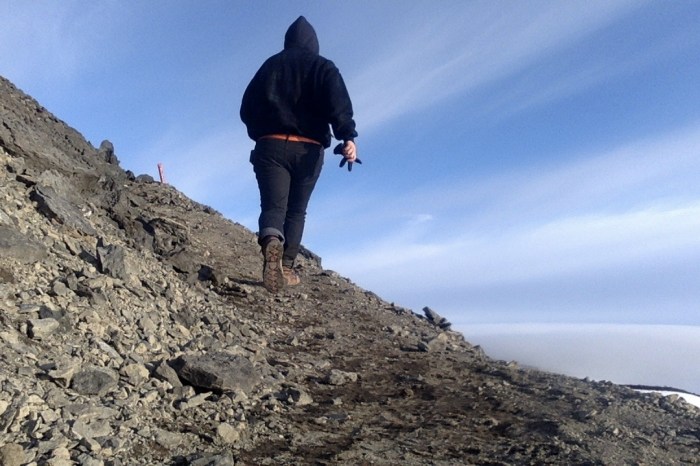
Me on the Ob Hill Loop Trail.

There are half a dozen or so hiking trails around McMurdo Station. Some are short, like the hike up Observation (Ob) Hill and down to Robert Scott’s hut near the ice edge. Some are long, like the 12-mile Castle Rock Trail, which requires a radio check-out with the firehouse and at least on companion with you on the trail. I have not yet hiked Castle Rock, but it’s on my short list of remaining first season Antarctica bucket list items.

The first trail I hiked, maybe a week after I arrived, was the two-mile Hut Point Ridge Trail. It was late October, temperatures rarely got above 10 degrees, and the wind chill was well below zero. And Antartica wind is STRONG. It IS the windiest continent on earth.

I thought I was going to be blown off the ridge, the wind was so strong.

Now that it’s the height of summer, with more sunny days and temps regularly reaching the low to mid 30s, hiking around the station feels like a pleasant form of exercise and solitude, and not an epic battle for survival. There is far less ice and snow on the trails now, and when you are out of the wind and walking in the sun, it can be quite comfortable.

When the wind picks up though, man is it still unpleasant.

My favorite hike is the two-mile-or-so Ob Hill Loop, which, as the name suggests, winds around Observation Hill. It can be completed in an hour and a half if you walk fast like I do, and it gets me far enough away from the station that I can enjoy some Antarctic nature and solitude, without being dangerously far away from the station if I start to get cold. And I can go from hot to cold and back again in the blink of an eye depending on what side of Ob Hill I’m walking on, and what kind of weather is swooping in across the ice shelf.

The land is quite beautiful. With all the snow melt, I can see the volcanic rock in more detail, and the different shades are lovely. There are some really incredible rocks here. Seeing thick walls of fog, clouds, and the occasional rainbow move across the ice and over the Transantarctic Mountains in the distance is also a treat.

It’s times like these that I feel like I am living on another world.


A Big Fish

SAM_3332
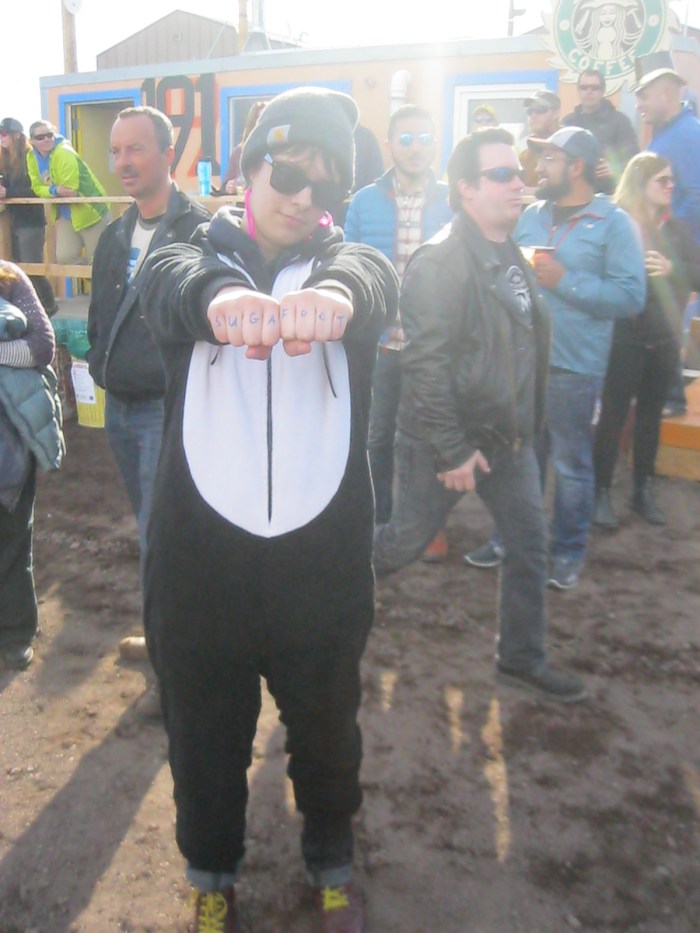
Me and my friend Luke, at Icestock

I feel like elaborating on one reason why I like life at McMurdo, even though it feels really narcissistic.

McMurdo’s current population is 773. For much of the season, it’s been between 600 and 900 people.

Our tiny town makes its easier for everyone to stand out. Peoples’ stories and talents show through in a way that they might not in a bigger community. You can be anonymous if you want, but if you have a crazy story or a cool skill that you want to share with the community, even a little bit, you will be known for it.

In Madison, there are dozens and dozens of violin/fiddle players. A lot of them are much better at their craft than I am. A few of them even make a living at it.

I’ve had two people at McMurdo who, after hearing me play, ask me why I’m not back home working as a professional musician.

I hate sounding conceited, and I KNOW I sound conceited right now, but no one in Madison has ever asked me that. You know how nice it is to feel like one’s abilities as a musician are *actually* impacting a community in a positive way?

Insanely nice. I LOVE my music community back home, but being a fiddle player at McMurdo has been so dang satisfying. As far as I know, I am one of the only fiddle players here. I might be the only one. And I love filling that little niche in a music scene dominated by guitarists and bass players.

Side note: I AM THE ONLY MELODICA PLAYER HEEEEEEEERE!!!!!

It’s a similar feeling with careers and notions of career “success.” I’ve semi-devoted myself to radio broadcasting since I was 16. Between WORT, WSUM, and Wisconsin Public Radio, Madison is bursting at the seams with quality radio broadcasting and broadcasting professionals. I have ridiculously talented colleagues. I have colleagues who are my age and far more “advanced” in their careers than I am because they have the drive,  discipline, and patience to devote themselves fully to a career path, rather than dabbling around in a little of everything, as I seem to do.

Here, no one cares what kind of career you have back in the “real world,” and no one seems too fussed about how your work here correlates with what you do back home. They just care that you do your job well, and then you’re decent to work with.

We have janitors and dishwashers here with masters degrees.

So not to diss Madison, because I freakin’ love the city that’s been my home for 95 percent of my life, but I sometimes feel like I fit in better at McMurdo than I do in Madison. I like being a big fish. I sometimes think my skills and contributions have a wider reach here than they do back home, even though no one needs helping starting a low-power radio station at McMurdo.

Not yet, at least 🙂


Icestock

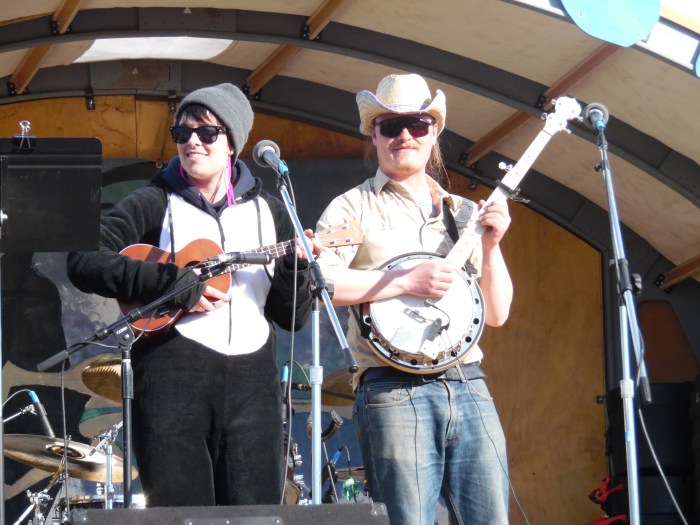
Icestock is McMurdo Station’s eight-hour New Year’s Eve outdoor music festival.

I first learned about Icestock six months before coming down here, and immediately added “play at Icestock” to my Antarctica bucket list.

Dream achieved. Playing with my band Sugarfoot at Icestock was an awesome early birthday present, and even though I had to leave the second half of the party to work night shift, it was still an amazing event.

Where else am I going to don a penguin onesie, play fiddle, ukulele, and melodica, sing an acoustic cover of “Umbrella” by Rihanna with my friend Ashlee, get the crowd going with a solo of “Three Thin Dimes,” and then do the world’s most awkward, cautious stage dive afterwards?

THANK YOU, ANTARCTICA!

Garbles from Aligarh

IMG_5655
Learning to use HF radio outside the comms shop. 

Shortwave radio is an especially nerdy slice of the radio frequency spectrum. Just typing the words “radio frequency spectrum” already qualifies me as a nerd to some extent. I am aware of this fact. But really, shortwave radio, for the most part, far exceeds my nerd  knowledge.

Nowadays, shortwave radio is used primarily by ham radio operators (most of whom are old white guys in their attics) and religious broadcasters like World Adventist Radio. But, it’s also used by folks in developing countries who don’t have reliable Internet, as well as some news agencies like the BBC and Voice of America.

Before coming to McMurdo, I had never used shortwave or HF (High Frequency) radio. Now, I talk to field camps, airplanes, and South Pole station on HF radio on a regular basis. It’s a highlight of my job.

It’s fun to live someplace where an old(er) technology is so commonplace, and it’s more glamorous than our other older technologies like corded phones and pagers. We use HF to communicate with field camps who can’t use our VHF radio repeaters. Sometimes we can reach camp staff faster on HF than we can with our satellite phones. And on night shift, when the radios are hissing and whining all night in MacOps, I can sometimes hear pop music and Pashto-language conversation from All India Radio in Aligarh in northern India.

Hearing live broadcasts from India whilst living in Antarctica is pretty neat.

On Christmas Eve, the McMurdo Christmas Choir, McMurdo’s one-note singing sensation group called The Monotones, and our vibraphone-playing firefighter came into MacOps and played music live on HF radio for all the field camps. Several camps performed their own music back, and it was such a delight to hear their music, coming to us live from hundreds of miles away. I have an acquaintance from New Jersey who was on the ice for a few weeks, and he is heavily involved in the ham radio community. He let ham operators know about the broadcast a few weeks in advance, and I was told later that the McMurdo Christmas Carol broadcast was heard as far away as Sweden.

I have hosted a lot of radio shows. I never thought that would include MC-ing a troupe of musicians at McMurdo Station, South Pole Station, and several camps in between, on HF radio.