Crary Lab

Most of the scientists working at McMurdo work in the Crary Lab. The Crary Lab has offices, facilities and equipment for scientists (with a focus on biology, ecology, geology, oceanography, and climatology), and a library.

Crary Lab has science lectures every Wednesday and semi-regular lab tours. I took a lab tour in late October during my first week here. The lab tours are a great opportunity for the support staff to get a close look at the science activities going on at the station.

My favorite part of the tour was the touch tank, which is a small salt-water talk holding small creatures that are commonly found under the Antarctic sea ice.

In addition to the Crary Lab tours and the Wednesday night science lecture, which geared more towards scientists, there is a Sunday night science lecture in the galley, which is geared towards the general populace. I have only attended a few lectures so far, although I’m hoping to attend more as my schedule allows. My favorite lecture included an advance screening of David Attenborough’s Blue Planet II, which won’t be widely released for another six months.


Ordinary Amazing and Special

My first several weeks here were spent in a blur of activity. One friend who’s been to McMurdo describes the town as “summer camp for adults.” I have to agree. When you aren’t working 54 hours a week, there is SO. MUCH. to do here.

Take a walk down “Highway One” in building 155, a large blue building where the galley and many dorms, offices, and recreation areas are located, and you will be greeted by dozens of flyers advertising recreation trips off station, open mic nights, trivia nights, “hard drive and chill” at the coffeehouse, sports leagues, the latest cribbage tournament, the half a doze yoga classes available, meditation group, swing dance, knitting group, Sunday and Wednesday night science lectures, and posters for the various shows on Ice Radio, among others.

As well as getting adjusted and learning my job, I spent a lot of time in mega adventure/tourist mode, constantly rushing from one place to the next in my FOMO (Fear of Missing Out). I wanted to do EVERYTHING.

The FOMO was exhausting, and fortunately, it had mostly burned off after my first month. I settled into some semi-regular activities I enjoy, like knitting group, playing in a band, volunteering in the library and craft room, and doing the occasional show on Ice Radio.

Now McMudo just feels like my home, where I live and work. It’s like no life I have ever lived, but I no longer feel overwhelmed and stunned by all the newness and activity. McMurdo Station still feels amazing and special, but it feels like an ordinary amazing and special.

The Ob Tube

About 100 feet onto the sea ice (the section of ice that melts for a few months out of the year), next to one of the dive huts, is a large pistachio-green metal tube that is installed in the sea ice and extends about 10 or so feet under the ice.

The Ob Tube is available only when the sea ice is a sufficient thickness, and I expect it will probably come out in a few weeks. While it’s there, you and at least one other person  (you cannot go alone for safety reasons) can go to the Ob Tube and take turns going inside and seeing the sea under the ice!

If you’re lucky, you will see seals, large fish, and even one of the divers. When I was there, I didn’t see any marine life larger than some small fish, but I did hear the occasional chirp and click from a seal.


Sticker Shock

A delightful quirk I did not expect at McMurdo Station is the community’s love of stickers. Take a peek at people’s water bottles and notebooks and you will likely see them plastered with stickers.

I’ve come to think of stickers here almost as a community art form/community media. Because McMurdo is managed by the federal government, forms of independent media that one might encounter in another tiny town, like a radio station or newspaper, don’t exist. We have a wonderful online newspaper, The Antarctic Sun, which is published by the National Science Foundation, and we also have a volunteer DJ-powered radio station, Ice Radio, which is programmed and supported by the American Forces Radio and Television Service (AFRTS).

But more on McMurdo’s broadcast media later. Stickers at McMurdo are used to share information, ideas, and in-jokes. Scientists will share stickers with their project’s name (called an “event number”) as well as some graphics that illustrate the focus of their work. Work centers, like MacOps, and groups handling large projects, like the South Pole Traverse, will make stickers that identify their line of work. And stickers that say things like “Go For Dale!” are only funny if you’ve been to McMurdo and were either in on an in-joke or had someone explain it to you. As it’s my first season, I’ve learned been introduced to some short and long-term jokes at the station through stickers, as well as patches and t-shirts, which are also popular ways of sharing jokes and forging community ties.

I’m sure the novelty has worn off for people who have been here multiple seasons, but I get a rush of delight when someone gives me a sticker. As well as being an awesome souvenir that takes up no space, it feels like a tiny initiation into the community. It’s like the person giving me the sticker is saying, “you’re one of us, and I want you to look the part.” Some stickers at McMurdo, like the ones I have in the right-hand photo, are sold in the station store and are available to everyone, but some stickers, like the “Check-in or Die” sticker, are available to a smaller number of people. If someone gives you a sticker like that, it feels like a big deal. You’ve indirectly become part of a group, or you’ve been informed of a joke not everyone knows about. In this way, you are ingrained into the community just a little bit more.


My Work

The United States Antarctica Program (USAP) is a program within the National Science Foundation (NSF).

Some people working at McMurdo are scientists (called “grantees”) who are here for anywhere from a few weeks to several months doing research. Most people here are contractors working for large companies that contract with the NSF to provide short-term support and make all the incredible scientific research possible.

There are food service folks, janitors (“janos”), tradespeople, field support staff, IT folks, and administrators, among others.

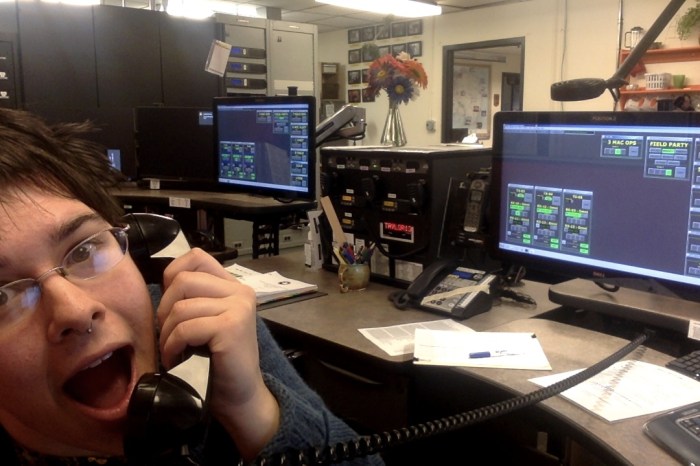
I work for a large multinational contracting company called Pacific Architects and Engineers, although it’s usually just known as PAE. I am working for PAE from mid October to late February as a Communications Operator. I work in the Operations Center, an office shared with MacCenter (they do air traffic control), MacWeather (weather forecasters and observers), and several small branches of the Air Force that handle polar science support.

I am one of five people working in the Operations Center. My co-comms operators are Josh, Rebecca, and Margot, and our supervisor is Shelly. Collectively, we are “The Voice of Antarctica.”

Communications Operators use phones, HF, and VHF radio to communicate with camps off station, track small field parties going on day trips, and relay slight schedules, transfer calls, and pass messages between scientists and staff out in the field and at McMurdo. It’s a fun job and it’s satisfying to have a support role in scientific research.

Photo on 11-17-17 at 3.41 AM